Agent AI Patterns for Agentic Workflows
Learn how reflection, planning, tool use, and multi-agent collaboration form the core of modern agentic AI systems.
Explore the Concepts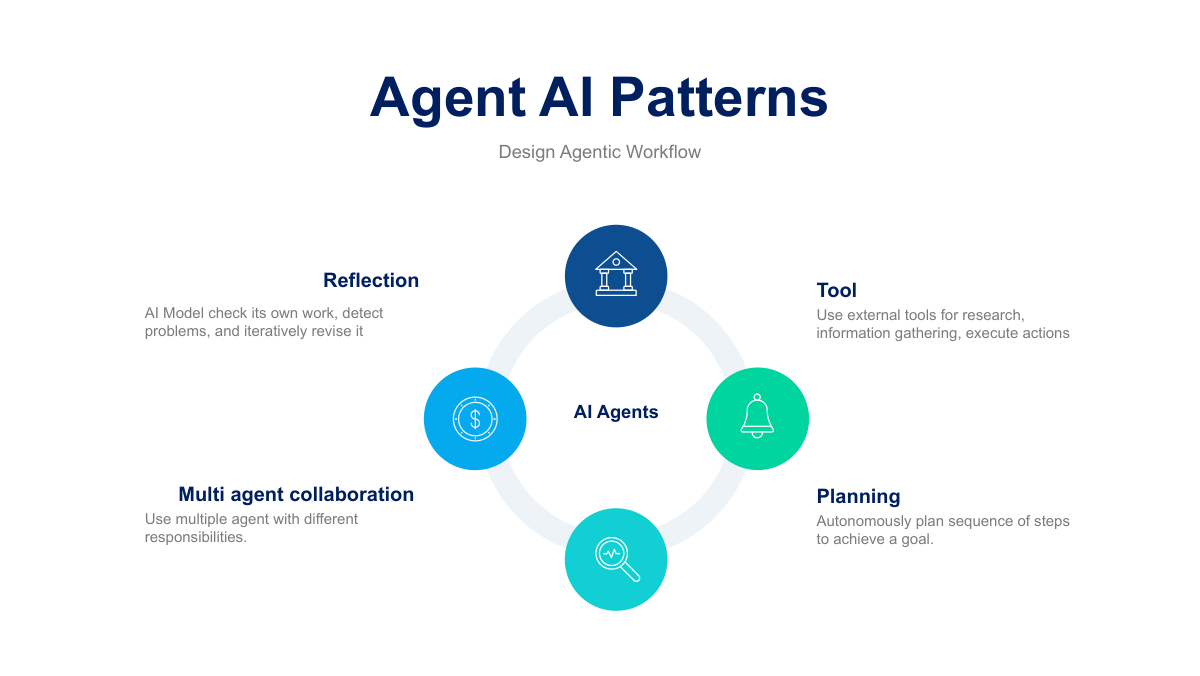
Learn how reflection, planning, tool use, and multi-agent collaboration form the core of modern agentic AI systems.
Explore the Concepts
Agentic AI workflows consist of interconnected processes that allow AI systems to think, adapt, plan, and collaborate. These workflows enable agents to break down problems, reason through them, use tools autonomously, and communicate with other agents to achieve complex goals.
Reflection helps agents self-evaluate their performance and refine their reasoning. Planning enables structured approaches to tasks. Tool use extends the agent’s capabilities beyond its base functions, allowing it to interact with external systems. Finally, multi-agent collaboration allows multiple specialized agents to work together efficiently.
These components form the backbone of next‑generation AI workflows designed for reliability, autonomy, and real-world applicability.
Agents self-evaluate, critique their reasoning, and refine outputs for improved accuracy.
Structured task breakdown enables agents to follow multi-step logical processes.
Agents extend capabilities by interacting with APIs, software tools, and external data sources.
Multiple agents coordinate, delegate tasks, and integrate findings for superior outcomes.
Continuous refinement loops yield more accurate, context-aware decisions.
Agents independently execute multi-step workflows across dynamic environments.
Improved autonomy enables agents to work independently with minimal supervision.
Enhanced reliability through iterative reasoning and reflection loops.
Scalable systems built from collaborative multi-agent architectures.
"Agentic workflows unlock the next frontier of AI — systems that think, plan, and collaborate autonomously."